Showing posts with label Nebula. Show all posts

Cocktail Astronomy | The Trifid and Lagoon Nebulae

New image by the Vera C. Rubin Observatory of the Trifid & Lagoon Nebulae. Image credit: NSF–DOE Vera C. Rubin Observatory

Here at Future-ish, we love astronomy and we love cocktails. So to prep our fans (and ourselves) for those stellar weekend cocktail conversations, we are pleased to offer a Cocktail Astronomy post on Fridays.

The Vera C. Rubin Observatory just keeps giving us more and more star candy. It recently gave us a new photo of two great friends, the Trifid and Lagooon Nebula located in the constellation Saggitarius around 4,000 to 6,000 light years from Earth. It's actually possible to see these BFFs without any aids, but binoculors or a telescope will certainly give you an even better look at these showy neighbors.

Some extras with these two: the Lagoon Nebula has an hourglass shaped nebula within it and the Trifid Nebula has become known for being a major star nursery.


Cocktail pairing: we went for two tasty drinks for this efferfescent duo, something pink and something blue so you can toast your BFF. We have Bon Appétit's Rosé-Aperol Spritz and Silver Factory's Lavendar Sky (via Bon Appétit).
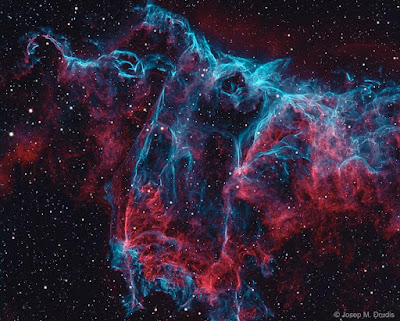
Cocktail Astronomy | The Bat Nebula

The Bat Nebula, (NGC 6995). Image credit: Joseph Drudis/NASA

Here at Future-ish, we love astronomy and we love cocktails. So to prep our fans (and ourselves) for those stellar weekend cocktail conversations, we are pleased to offer our Cocktail Astronomy post each Friday.

Boo! It's another Halloween weekend and what could be more appropriate for celebrating the holiday than a mysterious dark bat deep in space.

The Bat Nebula is located in the eastern part of the larger Veil Nebula, a massive supernova remnant. In this composite image of the neubula, it is the oxygen and nitrogen atoms that appear as different colors of blue. Just as haunting, the Witch's Broom Nebula (NGC 6960) is also located in the larger area of the Veil Nebula. The Veil Nebula is definitely a spooky place. Luckily, the Bat Nebula roosts about 1,400 light-years from Earth.


Cocktail Pairing: we're going with the Diamond Blue. Dark and mysterious but with a little bubbly and edible silver powder to add some celestial sparkle. Cheers!

Cocktail Astronomy | Enterprise Nebulae on Star Trek Day

Enterprise nebulae as seen by Spitzer Space Telescope. Credit: NASA/JPL-Caltech

Here at Future-ish, we love astronomy and we love cocktails. So to prep our fans (and ourselves) for those stellar weekend cocktail conversations, we are pleased to offer our Cocktail Astronomy post each Friday.

This week we join many of our fellow Trekkies in celebrating Star Trek Day and NASA's 2016 Spitzer Space Telescope images of nebulae that resemble two of the series' most famous star ships, Captain Kirk's USS Enterprise NCC-1701 and Captain Picard's Enterprise-D NCC-1701-D.

The nebulae (catalog numbers IRAS 19340+2016 and IRAS19343+2026) are located on the Milky Way's outer disk and are visible using Spitzer's infared technology that allows it to view objects deeper in space often obscured by dust.


Cocktail pairing: since Aldebaran whiskey made cameos in several Star Trek series, we suggest pouring a shot of your favorite whiskey from right here on Earth. And don't forget to raise that glass to 50 years of Star Trek ;-)

Cocktail Astronomy | Zombie Nebula Discovered

Image credit: NASA, NOAO, ESA, the Hubble Helix Nebula Team, M. Meixner (STScI), and T.A. Rector (NRAO)

Image credit: NASA, JPL, and K. Su

Here at Future-ish, we love astronomy and we love cocktails. So to prep our fans (and ourselves) for those stellar weekend cocktail conversations, we are pleased to offer our Cocktail Astronomy post each Friday.

OK, we admit it, we love zombies too. So with Halloween just around the corner, we wanted to bring a bit of our zombie crush into Cocktail Astronomy. Check out the nebula above...talk about a zombie transformation!? Discovered by Karl Ludwig prior to 1824, NGC 7293, the Helix Nebula (often referred to as the 'Eye of God)', is actually one of the most well known nebulas in astronomy and pop culture. It is a large planetary nebula located in the Aquarius constellation located about 650 light-years from Earth.

The first image from 2003 - pre-zombie - is a visible light image produced by combining data from the Hubble Telescope and NSF's .9 meter telescope at Kitt Peak. The second image - post-zombie - is an infrared image of NGC 7293 taken by the Spitzer telescope in 2007. Our newly named 'Zombie Nebula' It is a great example of how different telescopes with different spectral analysis reveal unique information about the objects being observed.

So have the bartender whip up one of those spooky Halloween cocktails (we suggest a 'brain tumor' or 'pina ghoulada') and let your friends know that zombies have invaded the cosmos. We're just happy that all the zombie dancers around the globe participating in the annual Thrill the World event that celebrates Michael Jackson's Thriller can look up into the sky and know that the big zombie eye in the sky is staring (hungrily) right back at them.

Cocktail Astronomy | Prawn Nebula


Here at Future-ish, we love astronomy and we love cocktails. So to prep our fans (and ourselves) for those stellar weekend cocktail conversations, we are pleased to offer our Cocktail Astronomy post each Friday.

Few things are more ubiquitous at any good happy hour than a prawn cocktail. So we are pleased to share one of our favorite nebulas located 6,000 light years from earth in the Scorpio constellation that goes by the same name, the Prawn Nebula (aka IC 4628 and Gum 56, named after Colin Stanley Gum). Whereas the prawn cocktail is simple recipe of shrimp and Mary Rose sauce, the Prawn Nebula has many more cosmic ingredients to spice things up. In fact, the mixture of elemental dust and gas clouds from collapsed stars makes the Prawn Nebula quite the active nursery for baby stars.

A new image of the nebula published by the ESO's Gems program in September 2015 used the MPG/ESO 2.2-m telescope at the La Silla Observatory in Chile’s Atacama Desert to create stunning detail of nebula and its ability to recycle the materials from old stars to create new ones.


Cocktail Pairing: French 75
Further Reading